work
CV/contact
news
texts
home


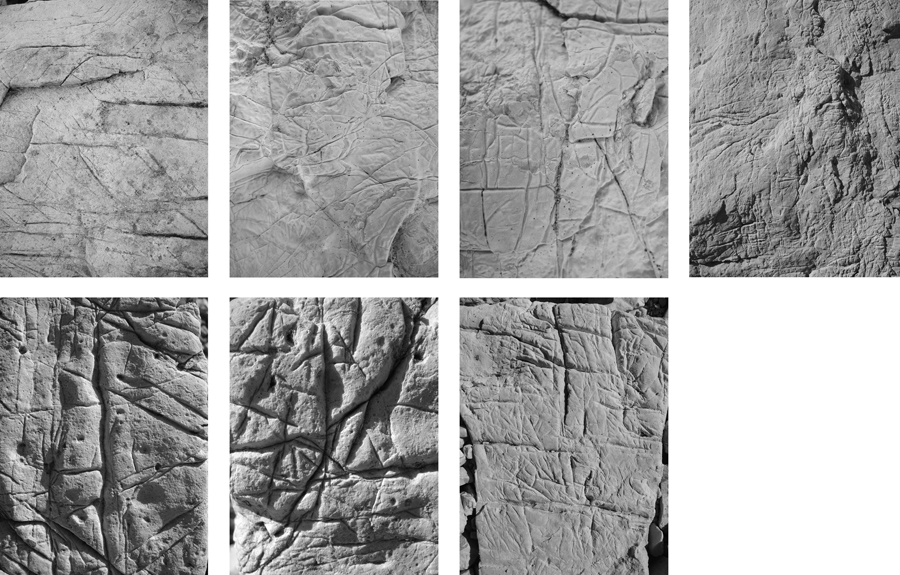
Beschreibung der Dolomiten / Description of the Dolomites, series of 49, inkjet prints on rice paper, 50.8 x 38.1 cm, 2015/2016

Photo #1 - 14

 
  Sibylle Eimermacher, photography  
     
  Sibylle Eimermacher, photography  
 

Description of the Dolomites is an archive of 49 photographs showing erosion structures in the rocks of the Dolomites. In these patterns I inevitably recognize similarities to human writing - a phenomenon that led me to question the boundary we usually draw between culture and nature. Is the development of writing really as uniquely human as we think? Or are our hands guided by some universal force or intelligence?

In a Mandaean spiritual text (the Mandaeans are a religious minority living mainly in the border region between Iran and Iraq), the divine creator himself, known as the King of Light, sees writing for the first time. He is so impressed and astonished that he exclaims: "Who created these letters? Not I - so there must be someone more powerful than me!" In other words: writing must have been produced by a divinity more powerful than the deity who created the world itself.*

The patterns in the Dolomites can be seen as manuscripts of the geological history of this mountain range; autobiographical inscriptions about their own past. The German word 'Beschreibung' in the title has a double meaning: 'to physically write on something' and 'to theoretically write about something'. A geological treatise on the Dolomites, written in stone by erosion - sun, rain, and frost. In many Indigenous cultures, the origin of writing is connected to cosmic events, often associated with the sun. Stone tablets also repeatedly play a role as surfaces on which the "divine" manifests itself. Scripts appeared to people in their dreams or during meditations and trances, after which they were written down and incorporated into their culture.

The Odùduwà Aibájiogbe script from Nigeria was revealed in 2011 to Chief Tolulase R. Oguntosin I. Taye. […] During a visit to an ancestral shrine he found a strange object, which he took with him to Porto-Novo in Benin. That night he slept with the object under his pillow. In his dream he was taken to the sun, where he saw a beam of light reflect onto a dark spot in the solar system. The beam of light revealed an alphabet, and again and again he heard the words in his mind: "Teach this to the world."*

*) From the exhibition texts of Alphabetum XV – Writing Systems of the Otherworld at West, The Hague, curated by Tim Brookes and Edgar Walthert

 
back
next